Knowledge Graph Scripture & Encyclopedia

Search & Explore

Multimedia Filter:
Suggested topics:
Found 36 topics & entities and 24 verses in 1770ms • Auto-routed to Keyword-First
Topic Overview

Rosetta Stone

Rosetta Stone (Interactive 3D Trilingual Decree • Isaiah 45:1 ): Granodiorite stele inscribed with three versions of a decree issued at Memphis in 196 BC on behalf of King Ptolemy V Epiphanes, key to deciphering ancient Egyptian. Within church history, this relates directly to Barton Warren Stone—Barton W. Stone was a Presbyterian minister on the Kentucky frontier who hosted the monumental Cane Ridge Revival of August 1801, subsequently withdrawing from the Presbyterian synod to dissolve his presbytery with the historic *Last Will and Testament of the Springfield Presbytery* (1804), calling on all denominational bodies to 'die, be dissolved, and sink into union with the Body of Christ at large.'

Church History Lineage & Historical Movements

Barton Warren Stone (Awakening & Restoration (1700–1900 AD)): Barton W. Stone was a Presbyterian minister on the Kentucky frontier who hosted the monumental Cane Ridge Revival of August 1801, subsequently withdrawing from the Presbyterian synod to dissolve his presbytery with the historic *Last Will and Testament of the Springfield Presbytery* (1804), calling on all denominational bodies to 'die, be dissolved, and sink into union with the Body of Christ at large.' American Restoration Movement (Awakening & Restoration (1700–1900 AD)): The American Restoration Movement (or Stone-Campbell Movement) arose on the American frontier in the early 19th century, led by Barton W. Stone, Thomas Campbell, Alexander Campbell, and Walter Scott, seeking the visible unity of all Christians by restoring the simple faith, order, and ordinances of the primitive New Testament church, under the watchwords: 'Where the Scriptures speak, we speak; where the Scriptures are silent, we are silent' and 'In essentials unity, in non-essentials liberty, in all things charity'. Split from presbyterianism. Catalyst: Cane Ridge Revival (1801) and Declaration and Address (1809).

Biblical Geography & Sacred Architecture

Key geographical locations connected to this topic include Serpent's Stone (Ancient biblical location referenced in 1 Kgs 1:9 (identified with En-rogel ).) The Stone Pavement (Ancient biblical location referenced in John 19:13 (identified with Jerusalem ).) 3D Sanctuary Reconstructions: Rosetta Stone — Granodiorite stele inscribed with three versions of a decree issued at Memphis in 196 BC on behalf of King Ptolemy V Epiphanes, key to deciphering ancient Egyptian. Magdala Synagogue Stone — Carved limestone block discovered at the center of the first-century Magdala synagogue depicting the Temple Menorah , oil jars, rosette, and the chariot of God.

Scripture Witness (KJV) & Canonical Context

Primary KJV scripture witnesses include 1 Kings 7:10 : "And the foundation was of costly stones, even great stones, stones of ten cubits, and stones of eight cubits."; John 10:31 : "Then the Jews took up stones again to stone him."; 1 Kings 5:17 : "And the king commanded, and they brought great stones, costly stones, and hewed stones, to lay the foundation of the house.".


Connected Topics & Entities Book/Chapter Verse Person Place Lexicon Theology Commentary History Perspective

Topics, People & Places (36)

Rosetta Stone 3D & AR
Rosetta Stone
99% 3D Model
Interactive 3D Trilingual Decree • Isaiah 45:1

Granodiorite stele inscribed with three versions of a decree issued at Memphis in 196 BC on behalf of King Ptolemy V Epiphanes, key to deciphering ancient Egyptian.

Rosetta Stone (Decree of Memphis)
99% direct_archaeological
196 BC Ptolemaic granodiorite trilingual decree that unlocked ancient Egyptian hieroglyphic script for modern historiography

A 1.12-meter granodiorite slab bearing a priestly decree in three scripts (Hieroglyphic, Demotic, and Ancient Greek), deciphered by Jean-François Champollion in 1822 to open the entire corpus of Egyptian biblical archaeology.

Serpent's Stone
99% Mapped Place
Biblical Place • En-rogel • 31.768°N, 35.234°E

Ancient biblical location referenced in 1 Kgs 1:9 (identified with En-rogel ).

The Stone Pavement
99% Mapped Place
Biblical Place • Jerusalem • 31.777°N, 35.235°E

Ancient biblical location referenced in John 19:13 (identified with Jerusalem ).

Magdala Synagogue Stone 3D & AR
Interactive 3D Carved Stone • Matthew 4:23

Carved limestone block discovered at the center of the first-century Magdala synagogue depicting the Temple Menorah , oil jars, rosette, and the chariot of God.

Mesha Stele (Moabite Stone) 3D & AR
Interactive 3D Epigraphic Inscription • 2 Kings 3:4–27

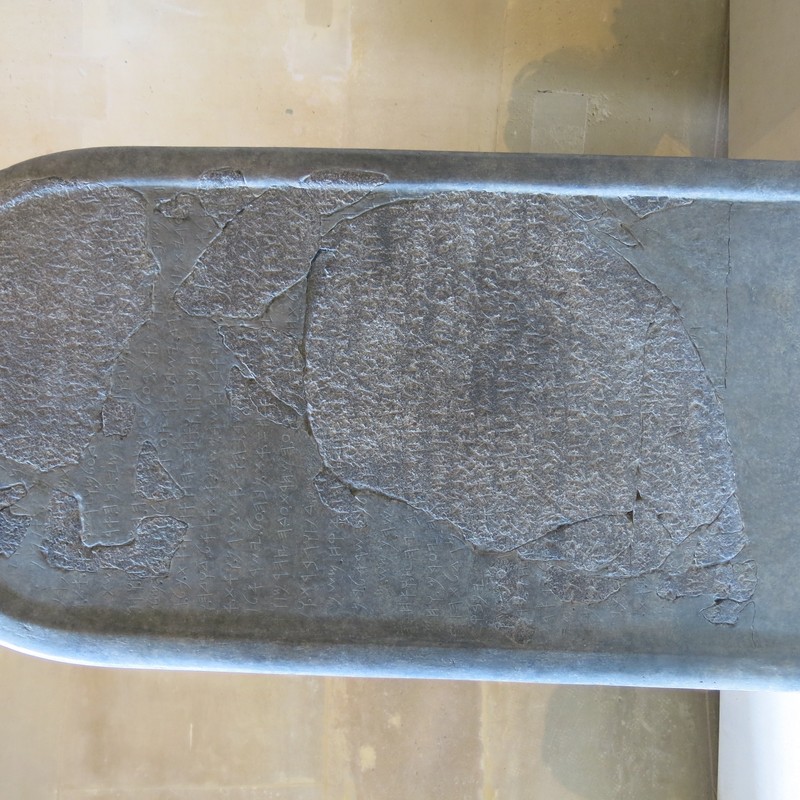
Black basalt victory stele erected by King Mesha of Moab recording his revolt against the House of Omri of Israel and mentioning YHWH and the House of David .

Pilate Stone (Caesarea Inscription) 3D & AR
Interactive 3D Epigraphic Slab • Matthew 27:2

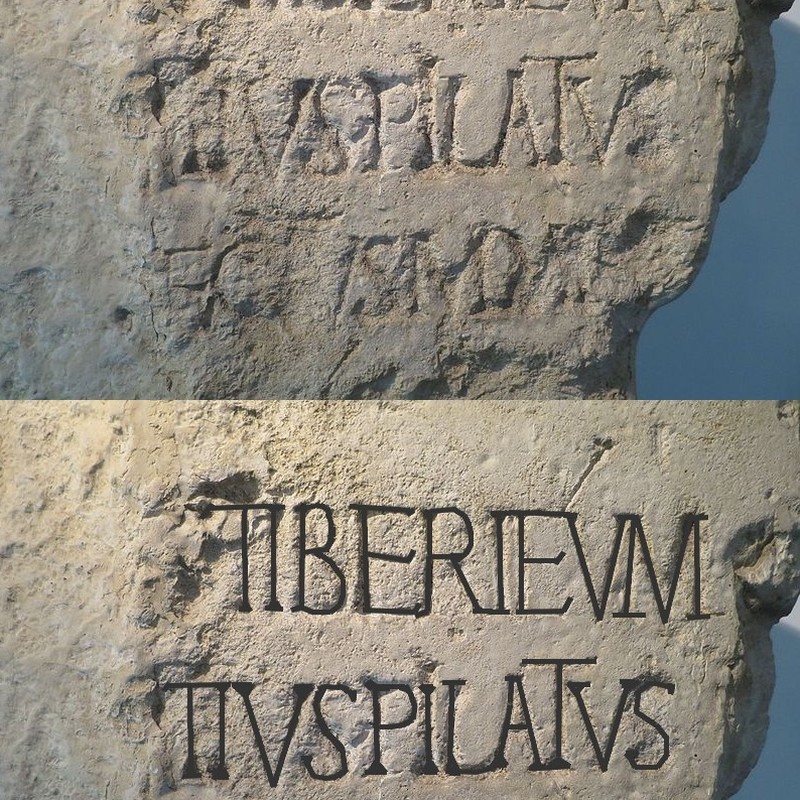
Carved limestone block from Caesarea Maritima bearing a Latin dedicatory inscription naming Pontius Pilatus, Prefect of Judaea.

Mesha Stele (Moabite Stone) — King Mesha of Moab & YHWH
IMAGE • archaeology

Inscribed black basalt slab (c. 840 BCE) recording King Mesha 's rebellion against Israel , mentioning Omri, Chemosh, and the Sacred Name YHWH.

Moabite Royal Scribes • Louvre Museum, Paris (AO 5066) / Wikimedia Commons Public Domain Mark 1.0
Stepped Stone Structure — Citadel of David / Millo
IMAGE • archaeology

Colossal 12-story high terraced retaining wall supporting the royal palace acropolis of the City of David .

Ancient Near Eastern Scribes and Stonemasons • The British Museum / Israel Antiquities Authority CC-BY-SA 4.0
Pilate Stone — Pontius Pilatus Inscription from Caesarea
IMAGE • archaeology

Limestone block discovered in Caesarea Maritima bearing a Latin dedicatory inscription naming 'Pontius Pilatus, Prefect of Judea ', confirming his historical governorship.

Roman Imperial Masons • Israel Museum / Civico Museo Archeologico di Milano / Wikimedia Commons CC-BY-SA 4.0
Pool of Siloam Stepped Stone Approach
IMAGE • archaeology

Monumental stone steps of the 225-foot Herodian mikveh/reservoir fed by the Gihon Spring where Jesus sent the blind man.

Curators & Archaeologists of City of David Archaeological Excavations • City of David Archaeological Excavations / Wikimedia Commons Public Domain Mark 1.0
Magdala Synagogue Stone
99% direct_archaeological
1st-century AD carved limestone reading block from Galilee featuring the earliest known Menorah carved during the Temple period

A richly carved limestone block found at the center of an excavated 1st-century Galilean synagogue, serving as a reading desk or Torah stand, decorated with relief carvings of the Second Temple Menorah , Showbread table, oil jars, and chariot wheels.

Magdala Synagogue Stone with Menorah
IMAGE • archaeology

Carved limestone block from the Magdala synagogue depicting the earliest known seven-branched Temple Menorah in Galilee .

Curators & Archaeologists of Israel Antiquities Authority • Israel Antiquities Authority / Wikimedia Commons Public Domain Mark 1.0
Mesha Stele (Moabite Stone)
99% direct_archaeological
9th-century BC royal Moabite monument mentioning Omri King of Israel and the Tetragrammaton (YHWH)

A 1.24-meter black basalt stele inscribed in the Moabite dialect of Northwest Semitic by King Mesha of Moab , recounting his rebellion against Israelite domination and restoring territories captured during the reign of Omri.

צוּר
sur (ṣûr) [tsoor]
H6697 Hebrew noun masculine 73x
rock, cliff, boulder, fortress

Massive boulder, cliff; paramount metaphor for divine unchangeableness, refuge, and strength ('The Rock, His work is perfect', Deuteronomy 32:4).

Derivation: From צוּר (H6696) to bind, besiege.
Monumental Stone Tomb of Cyrus the Great
IMAGE • artwork

Six-tiered limestone plinth and gabled burial chamber of Cyrus II the Great standing at the Achaemenid royal capital of Pasargadae.

Curators & Archaeologists of Pasargadae World Heritage Site, Iran • Pasargadae World Heritage Site, Iran / Wikimedia Commons Public Domain Mark 1.0
1st-century AD monumental Latin inscription confirming Pontius Pilate as Prefect of Judea ('Praefectus Iudaeae')

A carved limestone block reused as a theater step, preserving four lines of Latin dedicating a public building (Tiberieum) to the honor of Emperor Tiberius by 'Pontius Pilatus, Praefectus Iudaeae'.

Barton Warren Stone
99% THEOLOGIAN
Pioneer evangelist of Cane Ridge and author of the Last Will and Testament of the Springfield Presbytery

Barton W. Stone was a Presbyterian minister on the Kentucky frontier who hosted the monumental Cane Ridge Revival of August 1801, subsequently withdrawing from the Presbyterian synod to dissolve his presbytery with the historic *Last Will and Testament of the Springfield Presbytery* (1804), calling on all denominational bodies to 'die, be dissolved, and sink into union with the Body of Christ at large.'

Tel Dan High Place — Sacred Precinct of Jeroboam's Golden Calf
IMAGE • archaeology

Monumental stone podium and horned altar enclosure established by Jeroboam I at Dan to rival Jerusalem .

Northern Kingdom of Israel Stone Builders • Israel Antiquities Authority CC-BY-SA 4.0
Pontius Pilate Inscription Stone
IMAGE • archaeology

Limestone dedicatory block from the Caesarea theatre naming Pontius Pilatus, Prefect of Judaea.

Curators & Archaeologists of Israel Museum • Israel Museum / Wikimedia Commons Public Domain Mark 1.0
Uzziah Tablet — Second Temple Reburial of King Uzziah
IMAGE • archaeology

Aramaic inscription stone from the Mount of Olives reading 'Hither were brought the bones of Uzziah , king of Judah ; do not open!'.

Ancient Near Eastern Scribes and Stonemasons • The British Museum / Israel Antiquities Authority CC-BY-SA 4.0
Enuma Elish Creation Tablets — Mesopotamian Cosmogony
IMAGE • archaeology

Seven tablets recounting the battle between Marduk and Tiamat, contrasting with the monotheistic Genesis creation narrative.

Ancient Near Eastern Scribes and Stonemasons • The British Museum / Israel Antiquities Authority CC-BY-SA 4.0
Trumpeting Place Corner Stone
IMAGE • archaeology

Southwestern Temple Mount corner ashlar carved in Hebrew 'To the place of trumpeting to declare...'

Curators & Archaeologists of Israel Museum • Israel Museum / Wikimedia Commons Public Domain Mark 1.0
Library of Ashurbanipal Flood Tablet — Epic of Gilgamesh XI
IMAGE • archaeology

Cuneiform tablet discovered at Nineveh preserving the ancient Mesopotamian account of the catastrophic global deluge and ark.

Ancient Near Eastern Scribes and Stonemasons • The British Museum / Israel Antiquities Authority CC-BY-SA 4.0
Capernaum Ancient Limestone Synagogue Ruins
IMAGE • geography

Excavated 4th-century white limestone synagogue built directly upon the basalt foundation of the 1st-century synagogue where Jesus taught.

Wikimedia Commons contributor • Wikimedia Commons CC-BY-SA 3.0
Bar Kokhba Letters — Autographs of Shimon Bar Kokhba
IMAGE • archaeology

Military dispatches from the leader of the Second Jewish Revolt (132–135 CE) found in Nahal Hever.

Ancient Near Eastern Scribes and Stonemasons • The British Museum / Israel Antiquities Authority CC-BY-SA 4.0
Caiaphas Ossuary — Burial Box of High Priest Joseph Caiaphas
IMAGE • archaeology

Intricately carved limestone ossuary excavated in the Peace Forest south of Jerusalem , inscribed ' Joseph , son of Caiaphas' (Yehosef bar Qayafa).

Second Temple Jewish Stone Carvers • Israel Museum, Jerusalem (IAA 1990-487) / Wikimedia Commons CC-BY-SA 3.0
Frontier restoration movement seeking Christian unity on the apostolic New Testament pattern

The American Restoration Movement (or Stone-Campbell Movement) arose on the American frontier in the early 19th century, led by Barton W. Stone, Thomas Campbell, Alexander Campbell, and Walter Scott, seeking the visible unity of all Christians by restoring the simple faith, order, and ordinances of the primitive New Testament church, under the watchwords: 'Where the Scriptures speak, we speak; where the Scriptures are silent, we are silent' and 'In essentials unity, in non-essentials liberty, in all things charity'.

Jericho Walls — Neolithic and Bronze Age Defenses at Tel es-Sultan
IMAGE • archaeology

Stone revetment and collapsed mudbrick ramparts at ancient Jericho , the lowest and oldest fortified city on earth.

Ancient Near Eastern Scribes and Stonemasons • The British Museum / Israel Antiquities Authority CC-BY-SA 4.0
Behistun Inscription — Darius the Great Trilingual Relief
IMAGE • archaeology

Colossal rock relief in Iran carved in Old Persian, Elamite, and Babylonian, key to deciphering cuneiform and Persian royal decrees in Ezra .

Achaemenid Persian Stonemasons (Darius the Great) • UNESCO World Heritage Site, Bisotun CC-BY-SA 4.0
Capernaum White Limestone Synagogue Ruins
IMAGE • archaeology

Monumental limestone synagogue built directly atop the black basalt foundation of Jesus ' first-century Capernaum synagogue.

Curators & Archaeologists of Franciscan Custody of the Holy Land • Franciscan Custody of the Holy Land / Wikimedia Commons Public Domain Mark 1.0
Tel Dan Stele — 'House of David' (Bytdwd) Inscription
IMAGE • archaeology

Ninth-century BCE basalt stele fragment discovered in northern Israel preserving the earliest extra-biblical reference to King David 's dynasty (' House of David ').

Aram-Damascus Stonecutters • Israel Museum, Jerusalem / Wikimedia Commons CC-BY-SA 4.0
Scythopolis (Beth Shean) — Roman Theater & Decumanus
IMAGE • archaeology

Preserved basalt and limestone theater and colonnaded street of the chief city of the Decapolis .

Ancient Near Eastern Scribes and Stonemasons • The British Museum / Israel Antiquities Authority CC-BY-SA 4.0
Hezekiah Tunnel Inscription (Siloam Inscription)
IMAGE • archaeology

Paleo-Hebrew monumental inscription carved inside the bedrock of Hezekiah 's water tunnel commemorating the breakthrough of the two tunneling crews ( 2 Kings 20:20 ).

Royal Hebrew Stonecutters of King Hezekiah • Istanbul Archaeology Museums / Wikimedia Commons Public Domain Mark 1.0
En-Gedi Carbonized Scroll — Micro-CT Virtual Unrolling of Leviticus
IMAGE • archaeology

Burned parchment scroll from an ancient synagogue virtually unrolled with micro-computed tomography to reveal Leviticus 1 -2.

Ancient Near Eastern Scribes and Stonemasons • The British Museum / Israel Antiquities Authority CC-BY-SA 4.0
Erastus Inscription — Corinth City Treasurer (Romans 16:23)
IMAGE • archaeology

Paved limestone plaza inscription in ancient Corinth reading 'Erastus in return for his aedileship laid this pavement at his own expense'.

Roman Provincial Stonecutters at Corinth (1st Century CE) • Archaeological Site of Ancient Corinth, Greece CC-BY-SA 4.0

Scripture Passages (24)

And the foundation was of costly stones, even great stones, stones of ten cubits, and stones of eight cubits.

Then the Jews took up stones again to stone him.

And the king commanded, and they brought great stones, costly stones, and hewed stones, to lay the foundation of the house.

And Joshua said, Why hast thou troubled us? the Lord shall trouble thee this day. And all Israel stoned him with stones, and burned them with fire, after they had stoned them with stones.

And above were costly stones, after the measures of hewed stones, and cedars.

Onyx stones, and stones to be set in the ephod, and in the breastplate.

The stone which the builders refused is become the head stone of the corner.

And onyx stones, and stones to be set for the ephod, and for the breastplate.

Therefore thus saith the Lord God, Behold, I lay in Zion for a foundation a stone, a tried stone, a precious corner stone, a sure foundation: he that believeth shall not make haste.

And the rulers brought onyx stones, and stones to be set, for the ephod, and for the breastplate;

Now I have prepared with all my might for the house of my God the gold for things to be made of gold, and the silver for things of silver, and the brass for things of brass, the iron for things of iron, and wood for things of wood; onyx stones, and stones to be set, glistering stones, and of divers colours, and all manner of precious stones, and marble stones in abundance.

And all the congregation brought him without the camp, and stoned him with stones, and he died; as the Lord commanded Moses .

Having the glory of God: and her light was like unto a stone most precious, even like a jasper stone, clear as crystal;

Six of their names on one stone, and the other six names of the rest on the other stone, according to their birth.

They shall also bring up a company against thee, and they shall stone thee with stones, and thrust thee through with their swords.

A time to cast away stones, and a time to gather stones together; a time to embrace, and a time to refrain from embracing;

And Jacob said unto his brethren, Gather stones; and they took stones, and made an heap: and they did eat there upon the heap.

And Solomon's builders and Hiram's builders did hew them, and the stonesquarers: so they prepared timber and stones to build the house.

And the Lord said unto Moses , The man shall be surely put to death: all the congregation shall stone him with stones without the camp.

And they conspired against him, and stoned him with stones at the commandment of the king in the court of the house of the Lord.

And now, I pray you, consider from this day and upward, from before a stone was laid upon a stone in the temple of the Lord:

And they shall take other stones, and put them in the place of those stones; and he shall take other mortar, and shall plaster the house.

And they shall not take of thee a stone for a corner, nor a stone for foundations; but thou shalt be desolate for ever, saith the Lord.

But all the congregation bade stone them with stones. And the glory of the Lord appeared in the tabernacle of the congregation before all the children of Israel .

Link copied to clipboard
Article Wiki

Title

Open Page → Explore