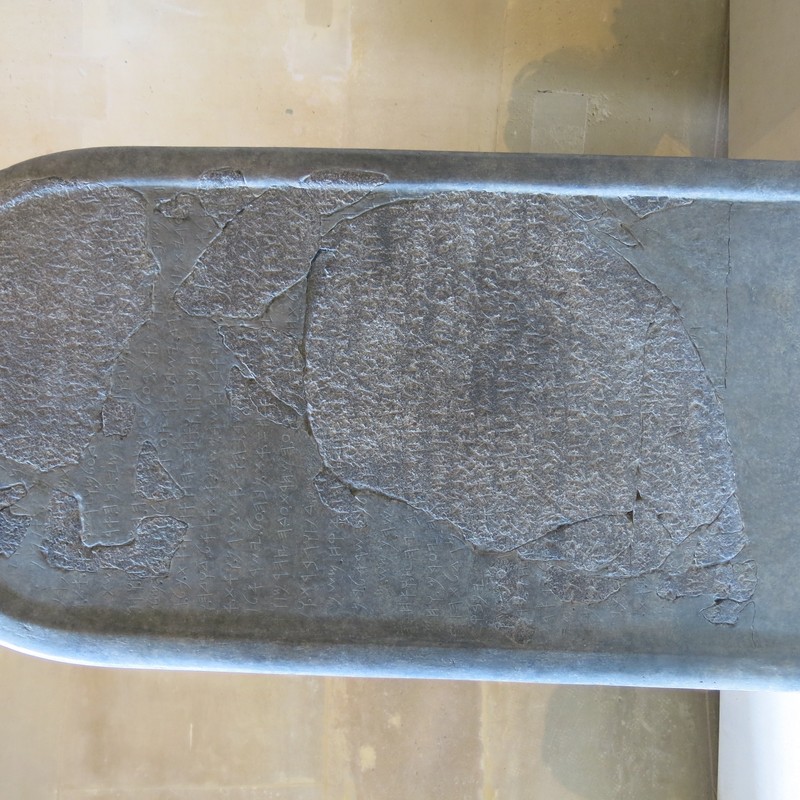
9th-century BC royal Moabite monument mentioning Omri King of Israel and the Tetragrammaton (YHWH)
T1Direct Archaeological Attestation98%
c. 840 BC
Discovery Excavation:Dhiban (biblical Dibon), Jordan (F.A. Klein, 1868)
Current Museum / Accession:Louvre Museum, Paris (AO 5066)
A 1.24-meter black basalt stele inscribed in the Moabite dialect of Northwest Semitic by King Mesha of Moab, recounting his rebellion against Israelite domination and restoring territories captured during the reign of Omri.
Corroboration Distribution for Connected Passages (17 records)
94% Confidence
17 sources
88.24%
Direct Archaeology15(88.24%)
Ancient Historians0(0%)
Dead Sea Scrolls & Manuscripts1(5.88%)
Scholarly Consensus1(5.88%)
Debated & Traditional0(0%)
Claim-by-Claim Epistemic Verification Breakdown
Rigorous 4-part empirical analysis separating ancient text from bias and consensus
1
Literal Translation / Primary Inscription
Epigraphic Record
Lines 4–18 read: 'Omri was king of Israel, and he oppressed Moab many days... But I saw my desire upon his son and upon his house, and Israel perished utterly forever!' Lines 17–18 record taking 'the vessels of YHWH' and dragging them before Chemosh.
2
Biblical Corroboration & Cross-References
Scriptural Harmony
Corroborates the geopolitical conflict between King Mesha of Moab and the Omride dynasty recorded in 2 Kings 3:4–27, as well as the worship of the national god Chemosh and early epigraphic recognition of YHWH.
Scholarly Debate, Historiography & Modern Consensus
Critical Nuance
Line 31 was reconstructed by André Lemaire (1994) as reading 'House of David' (bt[d]wd); in 2019 Finkelstein, Sass, and Römer argued for King Balak, while Lemaire and Rollston reaffirmed 'House of David'.
4
Ancient Author Bias, Royal Propaganda & Perspective
Ideological Context
Mesha ascribes his military setbacks to Chemosh's anger and his victories to Chemosh's favor. Mesha asserts that Israel 'perished utterly forever', a hyperbolic boast typical of Levantine royal inscriptions.