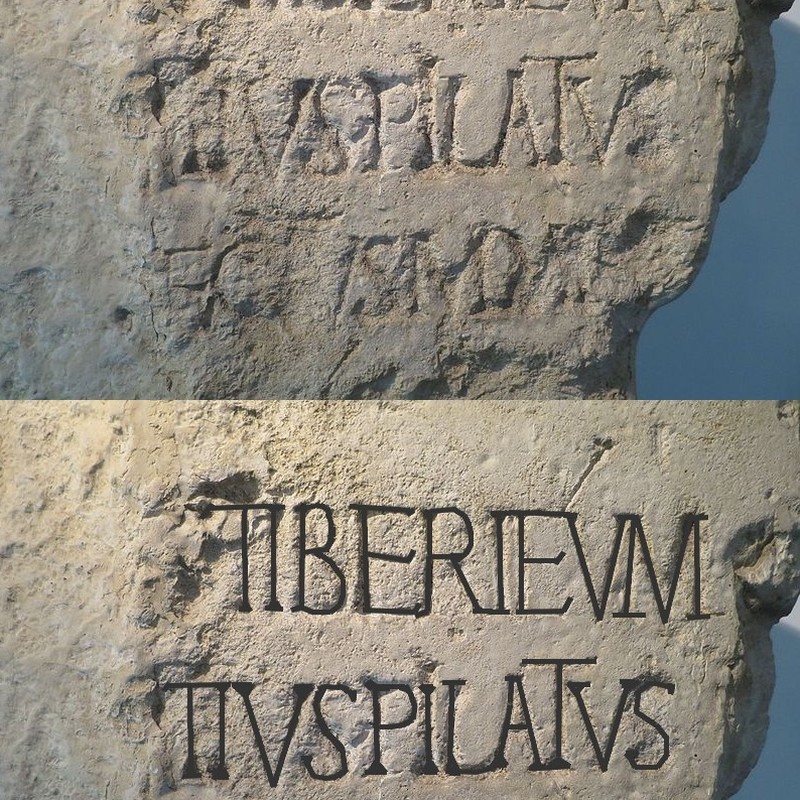
1st-century AD monumental Latin inscription confirming Pontius Pilate as Prefect of Judea ('Praefectus Iudaeae')
T1Direct Archaeological Attestation98%
c. 26–36 AD (Reign of Tiberius)
Discovery Excavation:Roman Theater, Caesarea Maritima, Israel (Antonio Frova, 1961)
Current Museum / Accession:Israel Museum, Jerusalem (AE 1963, 104)
A carved limestone block reused as a theater step, preserving four lines of Latin dedicating a public building (Tiberieum) to the honor of Emperor Tiberius by 'Pontius Pilatus, Praefectus Iudaeae'.
Corroboration Distribution for Connected Passages (61 records)
88% Confidence
61 sources
47.54%
31.15%
13.11%
Direct Archaeology29(47.54%)
Ancient Historians19(31.15%)
Dead Sea Scrolls & Manuscripts8(13.11%)
Scholarly Consensus1(1.64%)
Debated & Traditional4(6.56%)
Claim-by-Claim Epistemic Verification Breakdown
Rigorous 4-part empirical analysis separating ancient text from bias and consensus
1
Literal Translation / Primary Inscription
Epigraphic Record
The surviving Latin text reads: '[DIS AVGVSTI]S TIBERIEVM / [...PO]NTIVS PILATVS / [...PRAEF]ECTVS IVDA[EAE] / [...REF]EC[IT]'. Translated: 'To the Divine Augusti, Pontius Pilate, Prefect of Judea, dedicated this Tiberieum.'
2
Biblical Corroboration & Cross-References
Scriptural Harmony
Directly corroborates the historical identity and official imperial office of Pontius Pilate, Roman governor of Judea who presided over the trial and crucifixion of Jesus (`MAT.27:2`, `MAR.15:1`, `LUK.3:1`, `JHN.18:29`).
Scholarly Debate, Historiography & Modern Consensus
Critical Nuance
Confirmed Pilate's technical title before Emperor Claudius's administrative reorganization: Pilate was a military 'Praefectus' (prefect), whereas later Tacitus colloquially referred to him as 'procurator'.
4
Ancient Author Bias, Royal Propaganda & Perspective
Ideological Context
Civic dedication manifesting imperial loyalty to Emperor Tiberius by the governor, reflecting Roman civic-religious euergetism.